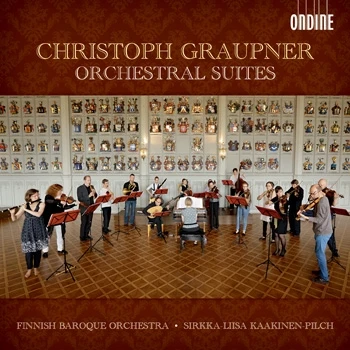
Christoph Graupner
Orchestral Suites
Finnish Baroque Orchestra
Sirkka-Liisa Kaakinen-Pilch, violin & conductor
Petra Aminoff, transverse flute
Tindaro Capuano, chalumeau
Asko Heiskanen, chalumeau*
Sirkka-Liisa Kaakinen-Pilch, viola d'amore
Krzysztof Stencel, baroque horn
Jani Sunnarborg, bassoon
Track listing
18 tracks · 75:54Listen to samples on selected tracks.
Christoph Graupner
- Suite for transverse flute, viola d?amore, chalumeau, strings and cembalo in F major, GWV 450 20:49
- 1 I Ouverture 6:16
- 2 II Air en Gavotte 2:12
- 3 III Hornepipe 2:28
- 4 IV Air en Sarabande 3:27
- 5 V Air en Polonese 1:27
- 6 VI Air en Menuet 4:53
- Suite for viola d?amore, bassoon, strings and cembalo in G major, GWV 458 25:18
- 7 I Ouverture 5:17
- 8 II Air 1:50
- 9 III Tempo di Sarabande 5:10
- 10 IV Tempo di Bourrée I/II 2:54
- 11 V Air: Largo 5:25
- 12 VI Menuet I/II 4:42
- Suite for transverse flute, viola d?amore, two chalumeaus, baroque horn, strings and cembalo in F major, GWV 451 29:53
- 13 I Ouverture 6:50
- 14 II Air 4:57
- 15 III Sarabande 3:41
- 16 IV Menuet I/IV 7:25
- 17 V Marche 1:34
- 18 VI Chaconne 5:26
About this recording
Music historians of our time invariably describe the early 18th century as the era of Johann Sebastian Bach. But if one were to have asked German musicians living at the time, they might well have described it as the era of Georg Philipp Telemann. The distinguished music encyclopedia published by Johann Gottfried Walther - J.S. Bach's cousin, as it happens - in 1732 devotes four times more space to the fashionable maestro of Hamburg than to the humble Thomaskantor.
Graupner's total surviving output comprises some 2,000 separate works, including ten operas, a hundred symphonies, a thousand cantatas, 85 orchestral suites and 44 concertos. A significant part of his orchestral output consists of concertos and suites with diverse, sometimes very curious instruments in the solo ensembles.
Among the rarer solo instruments he favoured were the flûte d'amour, a flute pitched a third lower than the normal transverse flute, and the viola d'amore, an instrument roughly the same size and shape as a viola but with resonating free strings in addition to the (usually) seven strings played with the bow. Combining the traverso and hunting horn in the same concerto, or the viola d'amore and the chalumeau, was extremely exceptional for the period.
What is significant in Graupner's music is his exceptional command of melody and harmony, which do not really resemble those of any of his contemporaries.
A second volume featuring Graupner's chamber music will be released in autumn 2014.
Features
Booklet with liner notes in English and Finnish.
Press
The performances by the Finnish Baroque Orchestra are exemplary.
Lindsay Kemp, Gramophone, February 2014
The artists
Finnish Baroque Orchestra
The Finnish Baroque Orchestra (Fibo) has made its mark on the Finnish classical music scene in many ways. Its national operations each year comprise concerts and education in dozens of localities. These are supplemented by mattress, home and institution concerts, foreign tours and other events designed to further interaction with the public at large. The orchestra's website is an expanding source of information on Baroque music, thanks to its modules aimed at different age groups.
Sirkka-Liisa Kaakinen-Pilch
Sirkka-Liisa Kaakinen-Pilch is an unusually versatile violinist. Though she plays music of every era, the emphasis in her repertoire is on the 17th to 19th centuries. She also plays the viola and viola d’amore and leads the orchestra or conducts from the front desk.
Petra Aminoff
Petra Aminoff began studying the flute at the Helsinki Conservatory and also played early music on the recorder. Having taken up the traverso at age 22, she gave up the modern concert flute, completed a recorder diploma and went to the Netherlands to study the traverso (1986-1987). She graduated from the Sibelius Academy in 1991 and was appointed a Lecturer of Recorder at Espoo Music Institute. She has been teaching ever since (at the Helsinki Conservatory and the Sibelius Academy) while performing early music with various orchestras (the Finnish Baroque Orchestra, the Helsinki Baroque Orchestra) and ensembles (Battalia, Opus X, the folk Baroque ensemble SAMA). Her particular focus is on developing her traverso playing and extending the repertoire of her instrument to Classical and contemporary music. She owns a variety of flutes from the Renaissance to the modern, with tunings ranging from 392 Hz to 442 Hz.