
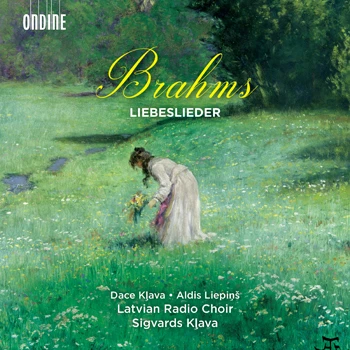
Johannes Brahms
Liebeslieder
Latvian Radio Choir
Sigvards Klava, conductor
Dace Klava, piano
Aldis Liepins, piano
Track listing
29 tracks · 48:57Listen to samples on selected tracks.
Johannes Brahms
- Drei Quartette, Op. 64, Nos 1-2
- 1 1 No. 1 An die Heimat (To my homeland) 4:33
- 2 No. 2 Der Abend (The evening) 3:49
- Vier Quartette, Op. 92
- 3 No. 1 O schöne Nacht! (O charming night!) 2:59
- 4 No. 2 Spätherbst (Late autumn) 1:28
- 5 No. 3 Abendlied (Evening song) 2:45
- 6 4 Warum? (Why?) 2:22
- Liebeslieder-Walzer, Op. 52
- 7 No. 1 Rede, Mädchen, allzu liebes (Tell me, maiden) 1:12
- 8 No. 2 Am Gesteine rauscht die Flut (O?er the rocks the tide roars on) 0:43
- 9 No. 3 O die Frauen (O the ladies) 1:20
- 10 No. 4 Wie des Abends schöne Röte (As the evening?s radiant sunset) 0:50
- 11 No. 5 Die grüne Hopfenranke (The green and trailing hopvine) 1:39
- 12 No. 6 Ein kleiner, hübscher Vogel nahm (A little, pretty bird) 2:20
- 13 No. 8 Wenn so lind dein Augen mir (When your eyes so softly gaze) 1:40
- 14 No. 9 Am Donaustrande (By Danube?s waters) 1:27
- 15 No. 10 O wie sanft die Quelle (See, how clear the ripples) 0:53
- 16 No. 11 Nein, est ist nicht auszukommen (No, there is no putting up) 0:58
- 17 No. 13 Vögelein durchrauscht die Luft (Little bird wings through air) 0:39
- 18 No. 14 Sieh, wie ist die Welle klar (See, how clear the ripples) 1:39
- 19 No. 15 Nachtigall, sie singt so schön (Nightingale, she sings so fine) 0:58
- 20 No. 16 Ein dunkeler Schacht ist Liebe (A well dark and deep is love) 1:16
- 21 No. 18 Es bebet das Gesträuche (A trembling stirs the bushes) 1:09
- Neue Liebeslieder, Op. 65
- 22 No. 1 Verzicht, o Herz, auf Rettung (Think not, o heart, of rescue) 0:47
- 23 No. 2 Finstere Schatten der Nacht (Threatening shadows of night) 1:40
- 24 No. 7 Vom Gebirge Well auf Well (From the mountains, wave on wave) 0:51
- 25 No. 8 Weiche Gräser im Revier (Tender, secret meadows) 1:44
- 26 No. 12 Schwarzer Wald, dein Schatten (Forest dark, your shadows) 1:27
- 27 No. 13 Nein, Geliebter, setze dich (No, beloved, do not sit) 1:42
- 28 No. 14 Flammenauge, dunkles Haar (Flaming eyes and raven hair) 1:46
- 29 No. 15 Zum Schluß: Nun, ihr Musen, genug (Now, you Muses enough!) 2:21
About this recording
Best known for his gigantic orchestral masterpieces Johannes Brahms (1833-1897) took equal pleasure in writing smaller miniatures. In fact, Brahms wrote a substantial number of pieces for vocal quartet and piano; this ensemble was for him a vehicle for expressing warmth and positive emotions, and as such this genre remains one of the most beloved in his output. This new recording by the prestigious Latvian Radio Choir under Sigvards Klava features a selection from his Opp. 52, 64, 65 and 92, including some of his famous Liebeslieder-Walzer.
Brahms wrote his earliest waltzes for piano duet and published them as op. 39 in 1865. Some years later, in 1868–1869, he went on to write the Liebeslieder-Walzer for vocal quartet and piano four hands op. 52. These, in turn, prompted a ‘sequel’ in Neue Liebeslieder op. 65 five years later. These warm and vivacious songs are a happy marriage of Viennese waltzes and the love poetry of Georg Friedrich Daumer, and biographers point to a romantic impulse stemming from Brahms’s amorous enchantment with the daughter of his close friend Clara Schumann, Julia. Brahms’s vocal quartets with piano accompaniment represent an interesting chamber-music approach to vocal music. They give the impression of being created for the purpose of intimate music-making at home, among friends. The Liebeslieder-Walzer quickly became one of Brahms’s most popular works.
Brahms’s op. 64, a set of three partsongs for quartet, was published in 1874. Op. 92 belongs essentially to Brahms’s late output. Its first partsong dates from 1877 and the other three from 1884. Despite the time gap, the partsongs in the set form a coherent and consistent whole. Three of the songs explore moods of evening and night, and the autumnal meditation of the second partsong fits in well.
Award-winning Latvian Radio Choir is among the most prestigious chamber choirs in Europe. The choir’s previous releases on Ondine have been highly successful. The recording of Rachmaninov’s All-Night Vigil (ODE 1206-5) was chosen as the Record of the Month, Editor’s Choice and received a nomination in the Gramophone Awards in 2013. Similarly, their recent release of choral works by Valentin Silvestrov (ODE 1266-5) received Gramophone Editor’s Choice.
Features
Sleeve notes in English
The artists
Latvian Radio Choir
The Latvian Radio Choir is a full-time professional chamber choir founded in 1940. Chief Conductor Sigvards Kļava and Conductor Kaspars Putniņš have led the choir since 1992. The ensemble's repertoire ranges from the Renaissance to the present day, with a primary focus on exploring the capabilities of the human voice and seeking to extend its limits. A major part of the repertoire is dedicated to contemporary music and composers of the 20th and 21st centuries. The choir is also open to creative experiments and often participates in dramatic performances and multimedia projects. The ensemble regularly commissions works from leading Latvian composers such as Pēteris Vasks and Ēriks Ešenvalds.
Sigvards Klava
Sigvards Kļava began working with the Latvian Radio Choir in 1987 and was appointed its Chief Conductor and Artistic Director in 1992. As one of Latvia's most prolific choral conductors, Sigvards Kļava has collaborated with every leading choir and orchestra in the country, performing the great works of the standard repertoire in addition to conducting most premieres of new choral works by Latvian composers. He has recorded numerous albums with the Latvian Radio Choir. Sigvards Kļava has also been Chief Conductor at a number of Latvian and Nordic song festivals. He is a co-founder of the Latvian New Music Festival ARENA and serves as a member of its artistic board. He teaches young conductors at the Choral Department of the Latvian Academy of Music and the Choral College of the Riga Lutheran Cathedral. Sigvards Kļava appears as a guest conductor with leading European choirs. He has received the Latvian Great Music Award and the Latvian Cabinet of Ministers Award.
Dace Klava
Dace Kļava is the Head of Accompanists Department at Jāzeps Vītols Latvian Academy of Music, as well as an associated professor at the Chamber Ensemble and Piano Accompaniment Department and accompanist at the Vocal Music, Choir and Orchestra Conducting Departments of the same institution. She has performed with a number of instrumentalists, vocalists and the Latvian Radio Choir, including acting as an accompanist in international vocal and conducting competitions.
Also recommended
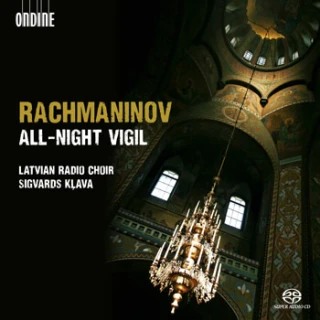
Sergei Rachmaninov
All-Night Vigil, Op. 37
Latvian Radio Choir · Sigvards Klava, conductor
Info & buy
Einojuhani Rautavaara
Missa a cappella · Sacred Choral Works
Latvian Radio Choir · Sigvards Klava
Info & buy