
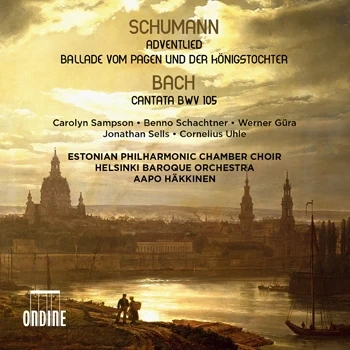
Robert Schumann · Johann Sebastian Bach
Adventlied, Op. 71 (World première recording)
Ballade vom Pagen und der Königstochter, Op. 140 · Cantata 105, version by Robert Schumann
Carolyn Sampson, soprano
Benno Schachtner, countertenor
Werner Güra, tenor
Cornelius Uhle, bass
Jonathan Sells, bass
Estonian Philharmonic Chamber Choir
Helsinki Baroque Orchestra
Aapo Häkkinen, conductor
Track listing
17 tracks · 70:54Listen to samples on selected tracks.
Robert Schumann
- Ballade vom Pagen und der Königstochter, Op. 140 32:03
- 1 Erste Ballade: Der alte König zog zu Wald 8:34
- 2 Zweite Ballade: Zwei Reiter reiten vom Königsschloss 5:47
- 3 Dritte Ballade: Den Runenstein in der Sommernacht (Nixe: Ülle Tuistk, soprano) 6:57
- 4 Vierte Ballade: Die Säle funkeln im Königsschloss 10:45
Johann Sebastian Bach
- Cantata BWV 105: Herr, gehe nicht ins Gericht 21:02 (version by Robert Schumann, Dresden 1849) 21:02
- 5 Chorus: Herr, gehe nicht ins Gericht 5:09
- 6 Recitative (alto): Mein Gott, verwirf mich nicht 0:59
- 7 Aria (soprano): Wie zittern und wanken 5:52
- 8 Recitative (bass): Wohl aber dem, der seinen Bürgen weiss 1:46
- 9 Aria (tenor): Kann ich nur Jesum mir zum Freunde machen 5:44
- 10 Chorale: Nun, ich weiss, du wirst mir stillen 1:32
Robert Schumann
- Adventlied, Op. 71
- 11 Dein König kommt in niedern Hüllen 2:05
- 12 Allmächt?ger Herrscher ohne Speere 4:48
- 13 Und wo du kommest hergezogen 2:10
- 14 O Herr von grosser Huld und Treue 2:50
- 15 Noth ist es, dass du selbst hienieden 1:01
- 16 O lass dein Licht auf Erden siegen 1:02
- 17 Und lösch? der Zwietracht Glimmen aus 3:53
About this recording
Helsinki Baroque Orchestra and the Estonian Philharmonic Chamber Choir led by Aapo Häkkinen join their forces together with an impressive vocal cast, Carolyn Sampson, Benno Schachtner, Werner Güra, Jonathan Sells and Cornelius Uhle, in this unique release of rarely heard choral works by Robert Schumann (1810-1856).
This recording includes the world première recording of Schumann’s 17-minute Adventlied, Op. 71 for soloists, chorus and orchestra, four choral ballades based on texts by Emanuel Geibel, and Schumann’s version of Bach’s Cantata BWV 105.
Robert Schumann wrote in 1850: “Keep in mind that there are also singers, and that the highest in musical expression is achieved through the chorus and orchestra.” This illustrates well the composer’s desire to write large works for this medium in an attempt to create a new genre for the concert hall. Today, they still constitute the least explored area of his output. The elevated style he was aspiring to (both in the text and the music) was unheard-of outside the realm of church music. In fact, whether for the church, opera, or the concert hall, Schumann was looking for a sanctified realm, a Goethe-inspired meeting ground for art and religion.
Adventlied, Op. 71, was written in November 1848 to a text from Friedrich Rückert’s Pantheon. The sense of urgent need and chromatic writing alternate with lyrical sections and quasi-Handelian grand climaxes in praise of universal brotherhood, featuring the transformed opening theme from time to time throughout the work. Schumann studied intensively approximately 500 works by Bach, including numerous still unpublished cantatas, and took them up again and again in order to “daily confess before this lofty man, and strive to purify and strengthen myself through him.” He conducted in Dresden in February-May 1849 the Adventlied and in July 1849 Bach’s dramatic cantata Herr, gehe nicht ins Gericht, BWV 105, and in Düsseldorf in October 1850 the Adventlied and, in the secular sphere, in November-December 1852 and again in March 1853 the large choral-orchestral ballade Vom Pagen und der Königstochter, op. 140, on texts by Emanuel Geibel. The work’s form bears a close resemblance to symphony. The four ballades are the unquestionable highpoint of Schumann’s modern, pervasively noble epic drama and peculiar way of storytelling.
Estonian Philharmonic Chamber Choir (EPCC) is one of the best-known Estonian music groups in the world. The repertoire of the choir extends from baroque to contemporary music, focusing on the work of Estonian composers. EPCC has cooperated with many outstanding conductors and orchestras, and has been a welcome guest at numerous music festivals and venues all over the world, including the BBC Proms and the Lincoln Center in New York, among others. The choir’s recordings have won several awards.
For twenty years, Helsinki Baroque Orchestra’s performances and recordings have been captivating audiences with a potent combination of emotional eloquence and infectious vitality. Their programmes frequently include first modern performances of unpublished or reconstructed masterpieces, and also shed unexpected and often provocative new light on more familiar works. Their music-making has contributed to the ensemble’s reputation as a major exponent of Baltic and German Baroque music. Helsinki Baroque’s sound has enthralled listeners from the Cologne Philharmonie to Tokyo’s Suntory Hall and the Amsterdam Concertgebouw, and at major festivals such as Bergen, Bremen, Rheingau, and Jerusalem.
Aapo Häkkinen is known as a distinguished chamber musician and director. Häkkinen has collaborated with several well-known artists around the world and programmed opera performances. Besides the harpsichord, he regularly performs on the organ, on the clavichord, and on the fortepiano. He has commissioned, given premières, and recorded music by various composers. He teaches at the Sibelius Academy and at international masterclasses (Tokyo University of Arts, Universidad Nacional de México, Kulturstiftung Marienmünster, Bratislava, Sofia, Tallinn, Tampere, Turku, Zagreb Academies of Music). He is Artistic Director of the Helsinki Baroque Orchestra and of the Helsinki Musiikkitalo Early Music Series as well as the Janakkala Baroque Festival.
Features
Sleeve notes in English, German lyrics with English translations
The artists
Carolyn Sampson
Equally at home on the concert and opera stages, Carolyn Sampson has enjoyed notable successes in the UK as well as throughout Europe and the US. On the opera stage her roles for English National Opera have included the title role in Semele and Pamina in The Magic Flute. For Glyndebourne Festival Opera she sang various roles in Purcell’s The Fairy Queen, now released on DVD. In 2012 she sang Anne Truelove The Rake’s Progress in Sir David McVicar’s new production for Scottish Opera. Internationally she has appeared at Opéra de Paris, Opéra de Lille, Opéra de Montpellier and Opéra National du Rhin. She also sang the title role in Lully’s Psyché for the Boston Early Music Festival, which was released on CD and was subsequently nominated for a Grammy in 2008.
Benno Schachtner
Benno Schachtner, countertenor, is widely regarded as one of the most promising singers in his field. With a special focus on music of the German Baroque period, he is much in demand as a soloist with some of the best ensembles committed to historic performance practice. Artists such as René Jacobs, Hans-Christoph Rademann and Howard Arman enjoy working with him. He has had concert performances in many of the most important cities of Europe and the USA. His many activities include performances at the Innsbruck Festival of Early Music, the Händel Festival in Halle, the Paris Philharmonie, and with the Seattle Symphony. Accompanied by the Canadian Tafelmusik Baroque Orchestra, in 2013 he accepted an invitation to perform at the International Bach Festival in Seoul, Korea, launching his Asian concert activity with an extraordinary program of solo arias. Through recent CD productions with René Jacobs, Stefan Temmingh, Christoph Spering, and the Akademie für Alte Musik Berlin, this exceptional singer has broadened his musical horizons. Recently, Benno Schachtner has chosen to focus particular interest on concert arias and oratorio.
Werner Güra
German tenor Werner Güra, born in Munich, received his musical training at the Mozarteum in Salzburg and completed his vocal studies with Professor Kurt Widmer. Furthermore, he was coached by Nicolai Gedda, Professor Margreet Honig, Amsterdam, and Professor Wessela Zlateva, Vienna.