
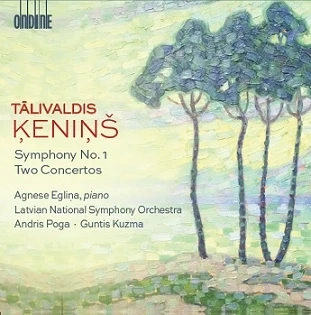
Talivaldis Kenins
Concerto di camera No. 1
Concerto for Piano · Symphony No. 1
Agnese Eglina, piano
Tommaso Pratola, flute
Martins Circenis, clarinet
Edgars Saksons, pecussion
Latvian National Symphony Orchestra
Andris Poga, conductor
Guntis Kuzma, conductor
Track listing
9 tracks · 57:49Listen to samples on selected tracks.
Talivaldis Kenins
- Concerto di camera No. 1 (1981) 20:28
- 1 I Moderato con moto 6:50
- 2 II Lento cantábile 6:45
- 3 III Vivo e marcato 6:53
- Concerto for Piano (1990) 19:22
- 4 I Molto vivace 7:59
- 5 II Largo quasi una Passacaglia 7:50
- 6 III Presto - Prestissimo 3:33
- Symphony No. 1 (1959) 17:59
- 7 I Moderato ma non troppo 3:23
- 8 II Largo e sostenuto 7:12
- 9 III Allegro molto 7:24
About this recording
Tālivaldis Ķeniņš (1919–2008) is a name that is not known to most classical listeners despite of his long international career as a composer. This album presents three orchestral works by one of Latvia’s greatest 20th century composers performed by the Latvian National Symphony Orchestra under the baton of Andris Poga and Guntis Kuzma.
Although born in Latvia, Ķeniņš lived most of his life as an exile. He was educated in Paris, where he studied under Tony Aubin and Olivier Messiaen, and won several awards. Ķeniņš emigrated to Canada in 1951 and became a respected pedagogue and a very influential figure in Canada’s music life. Alongside his pedagogic work he wrote a sizeable catalogue of works, including several symphonies and concertos.
According to Ķeniņš, chamber music was the highest form of art. His Concerto di camera No. 1 (1981) reveals his love for chamber music. The work contains hints of Bartók. The composer himself mentioned Mozart’s concertos as his model when writing the work.
Concerto for Piano, Strings and Percussion (1990) was completed shortly after the composer’s first visit to Latvia since the 1940s. Latvia was struggling to regain its independence and the work has a particularly tense and tragic atmosphere. When the work was premiered in Canada, the composer drew attention to the events unfolding in his home country when describing the work.
Ķeniņš wrote his First Symphony in 1959. This expressive work represents well the element of Latvian folk music in the composer’s work fusing it together with contemporary elements. Upon its premiere, the work received several performances in Canada, including CBC radio broadcasts.
The Latvian National Symphony Orchestra is one of the cornerstones of Latvian national culture, its history spans almost a century. The LNSO is a six-time winner of the Latvian Grand Music Award. Since 2013, the music director of the LNSO is maestro Andris Poga, a conductor sought after by top orchestras from around the world. The orchestra’s most notable former music directors include Jānis Mediņš, Leonīds Vīgners, Edgars Tons, Vassily Sinaisky, Olari Elts, and Karel Mark Chichon. Guntis Kuzma has been the orchestra’s conductor since the 2014/15 season and is the orchestra’s former principal clarinetist.
Features
Sleeve notes in English.
The artists
Agnese Eglina
Agnese Egliņa, winner of many international competitions, earned Latvia’s Grand Music Award 2010 for outstanding work in an ensemble. She collaborates with other musicians in various chamber ensembles and is one of the most sought-after pianists in Latvia. She has premiered over 50 newly written pieces by Latvian composers, including compositions dedicated to her contemporary music trio Art-i-Shock.
Tommaso Pratola
Tommaso Pratola is the principal flute of the Latvian National Symphony Orchestra since December 2019. Formerly, Tommaso was a member of the EU Youth Orchestra and Italian Youth Orchestra and the first flutist of the Teatro Petruzzelli Orchestra in Bari. In 2017, he received a scholarship from the Haus Marteau masterclass with Andrea Lieberknecht and an honourable mention at the Società Umanitaria International Competition.
Edgars Saksons
Edgars Saksons is a solo performer, chamber musician, orchestra player, and participant in various musical stage productions. Saksons is laureate of Latvia’s Grand Music Award 2001. Edgars’ stage partners include Steve Reich, Jonathan Haas, Ludwig Albert, Emmanuel Séjourné, Pavel Giunter, Marta Klimasara, Frédéric Macarez, and other renown masters of percussion.