Track listing
8 tracks · 63:12Listen to samples on selected tracks.
Ferdinand Ries
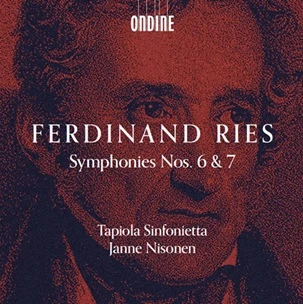
- Symphony No. 6 in D major, Op. 146 (1822) 30:54
- 1 I. Larghetto con moto – Allegro 10:04
- 2 II. Menuetto. Moderato – Trio – Poco più moto 4:41
- 3 III. Larghetto con moto 7:34
- 4 IV. Finale. Allegro con brio – Presto – Tempo primo 8:35
- Symphony No. 7 in A minor, Op. 181 (1835) 32:18
- 5 I. Allegro con spirito 9:59
- 6 II. Larghetto con moto 7:56
- 7 III. Scherzo. Allegro non troppo 5:02
- 8 IV. Introduzione. Largo – Finale. Allegro vivace – Tempo I – Allegro vivace – Tempo I – Allegro vivace 9:21
About this recording
The final volume in a new groundbreaking and much-praised complete symphony cycle of Ferdinand Ries’ (1784–1838) symphonies by the Tapiola Sinfonietta and conductor Janne Nisonen includes the composer’s two final statements in the symphony genre. Like most of his symphonies, also Ries’ Symphony No. 6 was premiered in London in 1822. His 7th Symphony, written a decade later, remained in the shadows and was published only in 2004. Both works, however, are full of discoveries.
Ries’ 6th Symphony proved to be the most popular of his symphonies, receiving performances in Düsseldorf and Leipzig in 1826, followed by Berlin (1827), Kassel (1828), a possible performance at the Paris Conservatoire in 1829 and further performances in London and Dublin in 1831. Based on contemporary reviews, it was considered that in this work Ries was “adopting a rather more lively style of composition: there is a new openness and freedom of melody”. While there is a great deal to admire in this symphony on a compositional level, it owed its popular success to Ries’ gift of writing attractive, memorable themes, thrilling, powerful passages to rival even those of Beethoven in their display of furious, concentrated energy, and the whole masterfully orchestrated. Every movement in this work has striking moments. The experience of conducting the German première of Beethoven’s Ninth was almost certainly the inspiration for Ries to add ‘Turkish music’ and two piccolos to the instrumentation and no doubt contributed a good deal to the impact the work.
Ries’ final completed symphony, Symphony No. 7, written for a society in Vienna more than a decade after Symphony No. 6, remained unpublished until 2004. This work exhibits a number of stylistic changes from Ries’ earlier works, not least of all in his treatment of the orchestra. The composer took great pride in this work, although, sadly, it is not documented that this symphony would have ever been performed during the composer’s lifetime.
The Tapiola Sinfonietta has established itself as Finland’s premier chamber orchestra. Founded as the Espoo City Orchestra in 1987, it currently has 44 members. The orchestra is known for its adventurous repertoire planning and has been widely acclaimed for nuanced performances across a wide range of eras and styles. The Tapiola Sinfonietta often performs without a conductor, placing an emphasis on ensemble playing and the personal responsibility of each musician. The Tapiola Sinfonietta appears regularly at music festivals in Finland, and tours abroad have boosted its international reputation along with its award-winning discography.
Janne Nisonen is one of Finland’s most versatile and sought after musicians. Nisonen is known especially for his stylish performances of classical and early romantic repertoire as well as a brave proponent of contemporary music. He is a descendant of folk musicians, and there is a certain full-blooded and gritty character in his musicianship. Among other orchestras, Nisonen has conducted the Finnish Radio Symphony Orchestra, Helsinki Philharmonic, Tapiola Sinfonietta, Tampere Filharmonia, Turku Philharmonic Orchestra, Avanti!, Tallinn Chamber Orchestra and the Ostrobothnian Chamber Orchestra. Nisonen has recorded exclusively for Ondine.
Features
Sleeve notes in English and German
The artists
Tapiola Sinfonietta
The Tapiola Sinfonietta has established itself as Finland’s premier chamber orchestra. Founded as the Espoo City Orchestra in 1987, it currently has 44 members. The orchestra is known for its adventurous repertoire planning and has been widely acclaimed for nuanced performances across a wide range of eras and styles.
Janne Nisonen
Janne Nisonen is one of Finland’s most versatile musicians performing as a conductor, leader, violin soloist and chamber musician. He began his violin studies at the age of four in Kokkola, Ostrobothnia and went on to study at the Sibelius Academy and Edsberg Chamber Music Institute in Stockholm, Sweden. Later he studied orchestra conducting with Hannu Lintu and Atso Almila at the Sibelius Academy.