
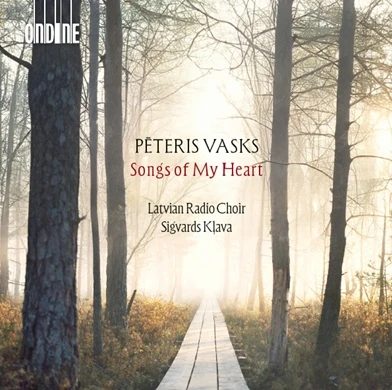
Track listing
20 tracks · 73:46Peteris Vasks
- 1 Actus caritatis (2021) 4:36
- 2 The Fruit of Silence (2013) 4:10
- 3 Pater noster (1995) 6:51
- 4 Angele Dei (2021) 4:53
- Love Songs (Mīlas dziesmas) (2013) 13:44
- 5 I. Such lightness (Tāds gaišums) 3:22
- 6 II. And suddenly such silence (Un pēkšņi tāds klusums) 2:48
- 7 III. Where was I? (Kur biju?) 2:00
- 8 IV. Then time stopped (Tad apstājas laiks) 3:17
- 9 V. Not a leaf is moving (Ne lapa nekustas) 2:17
- 10 Prayer (Lūgšana) (1961) 3:49
- 11 First Grass (Pirmā zāle) (2025) 4:05
- Six Songs (Šesas dziesmas ar Kn. Skujenieka vārdiem) (2025) 20:18
- 12 I. 3:40
- 13 II. 3:48
- 14 III. 2:25
- 15 IV. 4:21
- 16 V. 3:33
- 17 VI. I Wish You (Novēlējums) 2:31
- 18 Our Mountains (Mūsu kalni) (2017) 4:16
- 19 Within My Nation (Savā tautā) (1990) 4:07
- 20 Fatherland (Tēvu zeme) (2018) 2:57
About this recording
Pēteris Vasks (b. 1946) is considered among the leading Baltic composers of today and is known for his profound musical language. The award-winning Latvian Radio Choir conducted by Sigvards Klava are dedicating their new album to Peteris Vasks’ 80th birthday this year. The choir performs several world premiere recordings of Peteris Vasks’ choral music, including newly written works for the choir, as well as Vasks’ earliest choral composition, dating from 1961. All of the composer’s favoured themes find fertile ground in these works: pantheistic faith, love, silence and homeland. Essentially tonal and diatonic, slow-moving, homophonic and syllabic, fluid and linear, they possess a discreet grace and a fragile luminosity.
Although Pēteris Vasks regards himself primarily as a composer of instrumental music, his choral works have enjoyed considerable success in his homeland. Sadly, until the collapse of the Soviet Union, sacred music was strictly forbidden, and any other form of vocal music was acceptable only after passing through the censors’ gauntlet. From the 1970s onwards, Vasks therefore wrote little vocal music, and virtually no sacred music, for more than two decades. Until the mid-1980s, no sacred music rooted in the Christian tradition was performed at concerts organised by the Latvian Composers’ Union. The Latvian Radio Choir was among the few ensembles willing to champion a composer considered persona non grata by the regime and undeterred by his innovative language. The programme for this recording, conceived as a tribute to Pēteris Vasks on his eightieth birthday, spans a period of more than half a century and focuses on his intimate a cappella choral works in which he employs a simple, languid and deliberately conventional musical language.
The Latvian Radio Choir (LRC) ranks among the top professional chamber choirs in Europe and its refined taste for musical material, fineness of expression and vocal of unbelievably immense compass have charted it as a noted brand on the world map. The repertoire of LRC ranges from the Renaissance music to the most sophisticated scores by modern composers; and it could be described as a sound laboratory – the singers explore their skills by turning to the mysteries of traditional singing, as well as to the art of quartertone and overtone singing and other sound production techniques. The choir has established a new understanding of the possibilities of a human voice; one could also say that the choir is the creator of a new choral paradigm: every singer is a distinct individual with his or her own vocal signature and roles in performances. The choir’s album of John Cage choral works won a Gramophone award in 2023.
Sigvards Kļava is one of the most outstanding Latvian conductors, also a professor of conducting and producer, music director of the Latvian Radio Choir since 1992. As a result of Sigvards Klava’s steady efforts, the Latvian Radio Choir has become an internationally recognized, vocally distinctive collective, where each singer possesses a creative individuality. Under Sigvards’ guidance, the choir has recorded a number of choral works by little known or completely forgotten composers of the past, as well as formed a friendly collaboration with a number of notable Latvian composers. Sigvards Klava is a professor at the Jazeps Vitols Latvian Academy of Music. Klava is a multiple winner of the Latvian Great Music Award.
Features
Sleeve notes in English. Sung texts with English translations.
Includes world première recordings
The artists
Latvian Radio Choir
The Latvian Radio Choir is a full-time professional chamber choir founded in 1940. Chief Conductor Sigvards Kļava and Conductor Kaspars Putniņš have led the choir since 1992. The ensemble's repertoire ranges from the Renaissance to the present day, with a primary focus on exploring the capabilities of the human voice and seeking to extend its limits. A major part of the repertoire is dedicated to contemporary music and composers of the 20th and 21st centuries. The choir is also open to creative experiments and often participates in dramatic performances and multimedia projects. The ensemble regularly commissions works from leading Latvian composers such as Pēteris Vasks and Ēriks Ešenvalds.
Sigvards Klava
Sigvards Kļava began working with the Latvian Radio Choir in 1987 and was appointed its Chief Conductor and Artistic Director in 1992. As one of Latvia's most prolific choral conductors, Sigvards Kļava has collaborated with every leading choir and orchestra in the country, performing the great works of the standard repertoire in addition to conducting most premieres of new choral works by Latvian composers. He has recorded numerous albums with the Latvian Radio Choir. Sigvards Kļava has also been Chief Conductor at a number of Latvian and Nordic song festivals. He is a co-founder of the Latvian New Music Festival ARENA and serves as a member of its artistic board. He teaches young conductors at the Choral Department of the Latvian Academy of Music and the Choral College of the Riga Lutheran Cathedral. Sigvards Kļava appears as a guest conductor with leading European choirs. He has received the Latvian Great Music Award and the Latvian Cabinet of Ministers Award.