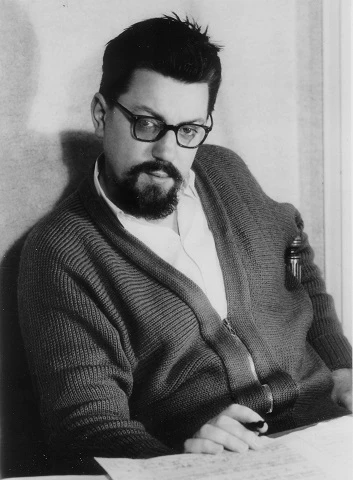
Although the size of his musical oeuvre is relatively small, Zimmermann occupies a key position in the history of German post-war music. He not only immersed himself in serial music and the strict concept of the Darmstadt avant-garde, but also combined these influences in a highly original manner with elements of jazz and quotations from historical compositions, thereby intriguingly anticipating the core concepts and techniques of so-called post-modernism. Zimmermann’s oeuvre includes compositions for orchestra - a Symphony (2nd version, 1953), a variety of ballet works and solo concertos - vocal works, chamber music and solo literature and electronic magnetic tape music. The Requiem for a young poet (1967/1969) can be viewed as a showcase for Zimmermann’s compositional development. The work is scored for large-scale forces including narrator, soloists, three choirs, electronic sounds, orchestra, jazz combo and organ. The texts selected by the composer range from political speeches, reports and liturgies to poems by Majakowski, Joyce, Pound, Camus, Schwitters und Bayer. The boundaries of the oratorio are pushed back towards the direction of radio play, reportage and features.
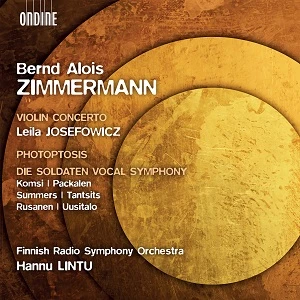
Zimmermann developed the concept of “pluralistic tonal composition” with the Sonata for cello solo (1960) and the Dialogues for 2 pianos and orchestra (2nd version, 1965). The superimposition of a variety of metres and rhythms produces a box form with differing time levels; quotations were also added. In the opera Die Soldaten (1957-1965), the technique of simulation was the central starting point (“sphericity of time”). The literary text, the play by J.M.R. Lenz, already splits open the unity of space and time: the various plot lines run parallel to each other. Zimmermann left the text of the play almost unaltered – elements of the text are additionally superimposed in a collage technique. The planned first performance of Die Soldaten in 1960 was initially postponed as the work was considered to be unplayable. The opera finally experienced its premiere at the Städtische Bühnen in Cologne in 1965: a sensational success which has continued up to the present day.
Zimmermann received a number of prizes, including the north Rhine-Westphalia Grand Art Prize (1960) and the Art Prize from the City of Cologne (1966). In 1965, Zimmermann was appointed as a member of the Academy of the Arts in Berlin.
(© Schott Music)