Sergei Rachmaninov
All-Night Vigil, Op. 37
Latvian Radio Choir · Sigvards Klava, conductor
Info & buy
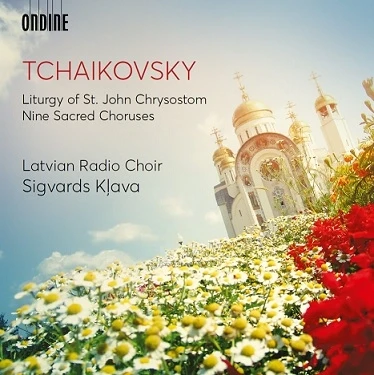
Peter Tchaikovsky
Nine Sacred Choruses
Latvian Radio Choir
Sigvards Klava, conductor
Listen to samples on selected tracks.
During the last decade, the recordings of sacred vocal works released on Ondine by the Latvian Radio Choir under their director Sigvards Kļava have gathered outstanding reviews and gathered several awards. This impressive cycle of recordings continue with a new album of Pyotr Tchaikovsky’s (1840-1893) sacred works.
In 1877, Tchaikovsky wrote in a letter to Nadezhda von Meck: “I often go to the public worship; in my opinion, the liturgy of St. John Chrysostom is one of the greatest works of art… Oh, I love all that terribly, it is one of my greatest pleasures.” Tchaikovsky enjoyed attending worship services, visited them regularly and always showed interest in sacred music, especially in the music of the Orthodox Church. Already relatively early in his career, in 1875, he issued “A short textbook of harmony, adapted to the reading of spiritual and musical compositions in Russia”, which in 1881 was approved as a textbook of church singing in theological seminaries and colleges. The same year, Tchaikovsky started editing the works of Dmitry Bortnyansky, a pioneer of sacred Orthodox music. However, he encountered problems with various institutions – the Imperial Chapel, the censorship authorities, as well as some conservative church officials who were more comfortable with smaller-caliber composers to whom they could have more authority when needed. Tchaikovsky wished to reform sacred Orthodox music but at the same to draw inspiration from the traditions of past centuries. Prime example of this is Tchaikovsky’s monumental work in sacred Orthodox music, the Liturgy of St. John Chrysostom, Op. 41. The Nine Sacred Choruses were written some years later. This work is not a cycle in the basic meaning of the word, but rather a collection, and another affirmation of Tchaikovsky’s skills as one of the greatest composers of Orthodox sacred music.
The Latvian Radio Choir (LRC) ranks among the top professional chamber choirs in Europe and its refined taste for musical material, fineness of expression and vocal of unbelievably immense compass have charted it as a noted brand on the world map. The repertoire of LRC ranges from the Renaissance music to the most sophisticated scores by modern composers; and it could be described as a sound laboratory – the singers explore their skills by turning to the mysteries of traditional singing, as well as to the art of quartertone and overtone singing and other sound production techniques. The choir has established a new understanding of the possibilities of a human voice; one could also say that the choir is the creator of a new choral paradigm: every singer is a distinct individual with his or her own vocal signature and roles in performances.
Sigvards Kļava is one of the most outstanding Latvian conductors, also a professor of conducting and producer, music director of the Latvian Radio Choir since 1992. As a result of Sigvards Klava’s steady efforts, the Latvian Radio Choir has become an internationally recognized, vocally distinctive collective, where each singer possesses a creative individuality. Under Sigvards’ guidance, the choir has recorded a number of choral works by little known or completely forgotten composers of the past, as well as formed a friendly collaboration with a number of notable Latvian composers. Sigvards Klava is a professor at the Jazeps Vitols Latvian Academy of Music. Klava is a multiple winner of the Latvian Great Music Award.
Sleeve notes in English. Lyrics in Russian transliteration and in English translation.
The Latvian Radio Choir is a full-time professional chamber choir founded in 1940. Chief Conductor Sigvards Kļava and Conductor Kaspars Putniņš have led the choir since 1992. The ensemble's repertoire ranges from the Renaissance to the present day, with a primary focus on exploring the capabilities of the human voice and seeking to extend its limits. A major part of the repertoire is dedicated to contemporary music and composers of the 20th and 21st centuries. The choir is also open to creative experiments and often participates in dramatic performances and multimedia projects. The ensemble regularly commissions works from leading Latvian composers such as Pēteris Vasks and Ēriks Ešenvalds.
Sigvards Kļava began working with the Latvian Radio Choir in 1987 and was appointed its Chief Conductor and Artistic Director in 1992. As one of Latvia's most prolific choral conductors, Sigvards Kļava has collaborated with every leading choir and orchestra in the country, performing the great works of the standard repertoire in addition to conducting most premieres of new choral works by Latvian composers. He has recorded numerous albums with the Latvian Radio Choir. Sigvards Kļava has also been Chief Conductor at a number of Latvian and Nordic song festivals. He is a co-founder of the Latvian New Music Festival ARENA and serves as a member of its artistic board. He teaches young conductors at the Choral Department of the Latvian Academy of Music and the Choral College of the Riga Lutheran Cathedral. Sigvards Kļava appears as a guest conductor with leading European choirs. He has received the Latvian Great Music Award and the Latvian Cabinet of Ministers Award.
Sergei Rachmaninov
Latvian Radio Choir · Sigvards Klava, conductor
Info & buyJohannes Brahms
Latvian Radio Choir · Sigvards Klava, conductor · Dace Klava, piano · Aldis Liepins, piano
Info & buyPeteris Vasks
Latvian Radio Choir · Sinfonietta Riga · Ilze Reine, organ (track 3) · Sigvards Klava, conductor
Info & buyGeorgy Sviridov
Latvian Radio Choir · Sigvards Klava
Info & buy