
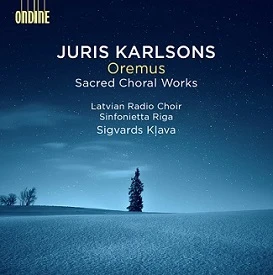
Juris Karlsons
Oremus...
Adoratio · Le lagrime dell'anima · Ora pro nobis
Track listing
7 tracks · 61:06Listen to samples on selected tracks.
Juris Karlsons
- 1 Oremus... (2018) 7:42
- Adoratio, symphony for choir and orchestra (2010) 33:30
- 2 Bars 1 - 86 7:27
- 3 Bars 87 - 314 14:34
- 4 Bars 315 - 389 5:35
- 5 Bars 390 - 460 5:54
- 6 Le lagrime dell?anima? (2013) 12:33
- 7 Ora pro nobis (2019) 7:21
About this recording
Composer Juris Karlsons (b. 1948) is one of the leading names in Latvian music today. This new album by the Latvian Radio Choir under their music director Sigvards Kļava features Karlsons’ choral works. These works are marked by deeply religious feeling and profound message.
Oremus is choral piece written by the composer in 2018 for the Latvian Radio Choir. It was premiered as part of the Lincoln Center White Light Festivals. When writing this work, no doubt Karlsons had specifically the sound and vocal abilities of the choir in mind. The largest work of the album is Adoratio (2010), a symphonic, single-movement work for choir and orchestra with a duration of over 30 minutes. Yet, this powerful work filled with drama can, like a symphony, be clearly divided into musical sections. Le lagrime dell’anima (2013) for piano and choir is based on a short poem written by the composer: “Here are just seven simple notes that are born on a beautiful summer evening when watching the sunset. The stars slowly light up, one, then another. You wait for the next one. The seven sounds of stars are gradually born under the pianist’s fingers, somewhere in the silence they appear in the chorus’s intonations, and finally intertwined in a melodic line,” the composer describes. The final piece of the album, Ora pro nobis (2019), is a tribute to Virgin Mary based on an earlier work and written for Sigvards Kļava.
The Latvian Radio Choir (LRC) ranks among the top professional chamber choirs in Europe and its refined taste for musical material, fineness of expression and vocal of unbelievably immense compass have charted it as a noted brand on the world map. The repertoire of LRC ranges from the Renaissance music to the most sophisticated scores by modern composers; and it could be described as a sound laboratory – the singers explore their skills by turning to the mysteries of traditional singing, as well as to the art of quartertone and overtone singing and other sound production techniques. The choir has established a new understanding of the possibilities of a human voice; one could also say that the choir is the creator of a new choral paradigm: every singer is a distinct individual with his or her own vocal signature and roles in performances.
Sigvards Kļava is one of the most outstanding Latvian conductors, also a professor of conducting and producer, music director of the Latvian Radio Choir since 1992. As a result of Sigvards Kļava’s steady efforts, the Latvian Radio Choir has become an internationally recognized, vocally distinctive collective, where each singer possesses a creative individuality. Under Sigvards’ guidance, the choir has recorded a number of choral works by little known or completely forgotten composers of the past, as well as formed a friendly collaboration with a number of notable Latvian composers. Sigvards Kļava is a professor at the Jazeps Vitols Latvian Academy of Music. Kļava is a multiple winner of the Latvian Great Music Award.
Features
Sleeve notes in English. Lyrics in original language and in English translation.
Sinfonietta Riga (2–5)
Vestards Šimkus, piano (6)
Solos: Agnese Pauniņa, soprano (1, 7); Agate Pooka, soprano (2–5);
Ieva Ezeriete, soprano (6); Pēteris Vaickovskis, baritone (2–5)
The artists
Latvian Radio Choir
The Latvian Radio Choir is a full-time professional chamber choir founded in 1940. Chief Conductor Sigvards Kļava and Conductor Kaspars Putniņš have led the choir since 1992. The ensemble's repertoire ranges from the Renaissance to the present day, with a primary focus on exploring the capabilities of the human voice and seeking to extend its limits. A major part of the repertoire is dedicated to contemporary music and composers of the 20th and 21st centuries. The choir is also open to creative experiments and often participates in dramatic performances and multimedia projects. The ensemble regularly commissions works from leading Latvian composers such as Pēteris Vasks and Ēriks Ešenvalds.
Sinfonietta Riga
Sinfonietta Rīga was formed in 2006. The orchestra of 34 young musicians is led by artistic director, oboist and conductor Normunds Šnē. Sinfonietta Rīga's musical direction and repertoire development are based on two principal aims: to pass on the rich traditions of music to the next generation of performers and audiences and to enlighten their listeners by presenting a thoroughly modern selection of works. The orchestra has performed with such soloists and conducters as Baiba Skride, Patrick Gallois, Roger Muraro, Martin Grubinger, Kirill Troussov, Alina Pogostkina, Peter Donohoe, Claudia Barainsky, Monica Groop, Sigvards Kļava, Heinz Holliger, Christoph Poppen and Juha Kangas. Both in 2007 and in 2008, Sinfonietta Rīga received the the Great Music Award of Latvia.
Also recommended
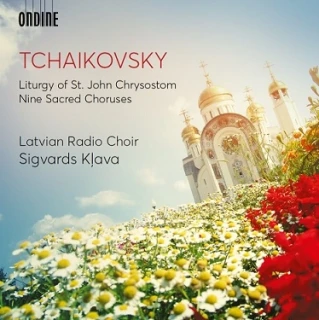
Peter Tchaikovsky
Liturgy of St. John Chrysostom · Nine Sacred Choruses
Latvian Radio Choir · Sigvards Klava, conductor
Info & buy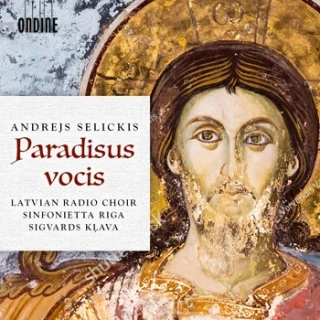
Andrejs Selickis
Paradisus vocis · Sacred choral works
Latvian Radio Choir · Sigvards Klava, conductor
Info & buy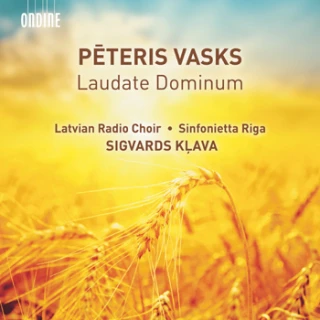
Peteris Vasks
Da pacem, Domine · Mein Herr und mein Gott · Laudate Dominum · Prayer (Lord, open our eyes) · The Fruit of Silence
Latvian Radio Choir · Sinfonietta Riga · Ilze Reine, organ (track 3) · Sigvards Klava, conductor
Info & buy