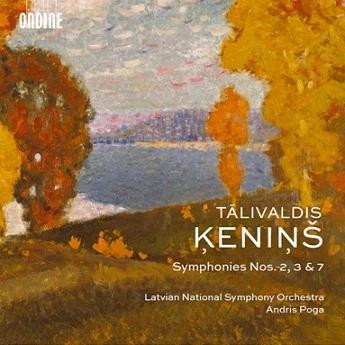
Final volume in the first-ever complete recorded cycle of symphonies by Tālivaldis Ķeniņš (1919–2008), one of the most prominent post-WW2 composers in Latvia and Canada. This album includes three of the composer’s eight numbered symphonies performed by the Latvian National Symphony Orchestra under Andris Poga.
Although born in Latvia, Ķeniņš lived most of his life as an exile. He was educated in Paris, where he studied under Tony Aubin and Olivier Messiaen, and won several awards. Ķeniņš emigrated to Canada in 1951 and became a respected pedagogue and a very influential figure in Canada’s music life. Alongside his eight symphonies, the composer also wrote 12 concertos. However, he also included many concertante elements in his symphonies and the Symphony No. 2, “Sinfonia concertante” (1967), scored for three wind instruments and symphony orchestra, is very close to a triple concerto. The symphony’s extensive second movement is based on a lullaby of the Mi’kmaq First Nations people. Symphony No. 3 (1970) was completed few years after its predecessor and is a step forward in the composer’s journey as a symphonist. Here we encounter the idea of a lyrical hero, which, in the ears of the listener, could be personified. Although many consider Kenins’ 8th Symphony to be his symphonic climax, the 7th Symphony (1980) is by no means a lesser work: it could be even considered as one of the composer’s most personal and intimate creations. The symphony ends with an aria based on a text by the composer’s father and the atmosphere of the work seems to stem from the composer’s emotional trauma on the occupation of his native Latvia by the Soviet troops.
The Latvian National Symphony Orchestra is one of the cornerstones of Latvian national culture, its history spans almost a century. The LNSO is a six-time winner of the Latvian Grand Music Award. Since 2013, the music director of the LNSO is maestro Andris Poga, a conductor sought after by top orchestras from around the world. The orchestra’s most notable former music directors include Jānis Mediņš, Leonīds Vīgners, Edgars Tons, Vassily Sinaisky, Olari Elts, and Karel Mark Chichon.
Andris Poga is the Chief Conductor of the Stavanger Symphony Orchestra since 2021/22 season. He was the Music Director of the Latvian National Symphony Orchestra (LNSO) from 2013 till 2021 and will continue to collaborate with the LNSO as its Artistic Advisor. He is frequent guest conductor with the leading orchestras of Germany, France, Italy, Japan and Scandinavia. After the first successful collaborations he has been invited back to the Tonhalle-Orchester Zürich, DSO Berlin, NDR Elbphilharmonie Orchester Hamburg, Gewandhausorchester Leipzig, SWR Symphony Stuttgart, WDR Sinfonieorchester, NHK Symphony Orchestra Tokyo and many others. He has also conducted the Wiener Symphoniker, Saint Petersburg Philharmonic, Accademia Nazionale di Santa Cecilia, Orchestre National de France, Royal Philharmonic Orchestra, Hong Kong Philharmonic, Sydney Symphony.