Track listing
21 tracks · 70:40Listen to samples on selected tracks.
Leos Janácek
- Sonata 1. X. 1905 (From the Street) 12:17
- 1 Foreboding 5:34
- 2 Death 6:43
- In the Mists 14:51
- 3 I. Andante 3:08
- 4 II. Molto adagio 4:20
- 5 III. Andantino 2:21
- 6 IV. Presto 5:02
- On an Overgrown Path, Book 1
- 7 Our Evenings 2:57
- 8 A Blown-Away Leaf 2:38
- 9 Come With Us! 1:29
- 10 The Madonna of Frydek 2:56
- 11 They Chattered Like Swallows 2:01
- 12 Words Fail! 1:59
- 13 Good Night! 2:46
- 14 Unutterable Anguish 3:55
- 15 In Tears 2:36
- 16 The Barn Owl Has Not Flown Away! 3:44
- On an Overgrown Path, Book 2 16:41
- 17 Andante 3:07
- 18 Allegretto - Presto 2:58
- 19 Paralipomena: Più mosso 2:51
- 20 Paralipomena: Allegro 5:40
- 21 Paralipomena: Vivo 1:55
About this recording
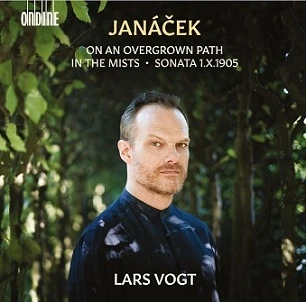
Pianist Lars Vogt’s new solo album release is dedicated to the piano works of Leoš Janácek (1854–1928), one of the most original voices among the 20th century composers. This album includes three of the composer’s most well-known and most extensive solo piano works. These works by Janácek are marked by deep melancholy and passion. They manifest the composer's rich inner world through a musical language that remains to be timeless.
On an Overgrown Path is a piano cycle which took many shapes during a period of a decade when the composer was slowly sketching the work. The first book containing ten pieces was published in 1911. Already the same year Janáček started drafting a second book which was never completed during the composer’s lifetime: a collection of 5 pieces for the second book was published in the 1940s. These short and fragmentary pieces with evocative titles are filled with deep and mysterious atmosphere. Janáček’s popular In the Mists is a short cycle of piano pieces written in 1912, immediately after the completion of the first book of On an Overgrown Path. These melancholic pieces are hinting towards the harmonies of Debussy without ever losing their essentially Janáčekian characteristics. Piano Sonata 1. X. 1905 ‘From the Street’ is what remains of an originally three-movement piano sonata premiered in 1906. The work was inspired by the killing of a young worker during a demonstration in Brno on 1 October 1905. The composer was not satisfied with the score and destroyed it later regretting this impulsive act. Fortunately, first two movements of this deeply intensive work were re-discovered and published in 1924.
Lars Vogt was appointed the first ever “Pianist in Residence” by the Berlin Philharmonic in 2003/04 and enjoys a high profile as a soloist and chamber musician. His debut solo recording on Ondine with Bach’s Goldberg Variations (ODE 1273-2) was released in August 2015 and has been a major critical success. From September 2015 Vogt has been Music Director of Royal Northern Sinfonia at Sage Gateshead, a position which he has held for five years before becoming Principal Artistic Partner of the orchestra. In 2020, Vogt was announced as the next Music Director of Orchestre de Chambre de Paris. Lars Vogt was nominated for Gramophone’s Artist of the Year award in 2017. His recordings of Beethoven’s Piano Concertos Nos. 2 & 4 (ODE 1311-2) together with the Royal Northern Sinfonia and an album of Dvořák’s Piano Trios (ODE 1316-2) both received Gramophone’s Editor’s Choice as well as the recent album of Mozart’s Piano Sonatas (ODE 1318-2). The recent installments in his Brahms concerto series also received Gramophone’s Editor’s Choice in January 2020 (ODE 1330-2) and BBC Music Magazine Concerto Choice in August 2020 (ODE 1346-2).
Features
Sleeve notes in English and German
The artists
Lars Vogt
Born in the German town of Düren in 1970, Lars Vogt came to public attention when he won second prize at the 1990 Leeds International Piano Competition and since then enjoyed a varied career. His versatility as an artist ranged from the core classical repertoire of Mozart, Beethoven, Schumann and Brahms to the romantics Grieg, Tchaikovsky and Rachmaninov through to the dazzling Lutoslawski concerto. During his late years Lars Vogt was increasingly working with orchestras both as conductor and directing from the keyboard. His appointment as Music Director of the Royal Northern Sinfonia at the Sage, Gateshead and Orchestre de chambre de Paris reflected this new development in his career.
Also recommended
Franz Schubert
Four Impromptus D 899 (Op. 90) · Six German Dances · Moment musicaux D 780 (Op. 94)
Lars Vogt
Info & buy